| Notes to page 1 |
|
|
|
|
|
|
|
|
|
|
|
|
|
|
|
|
|
|
|
|
|
|
| 1 |
|
|
|
|
|
|
|
|
|
|
|
|
|
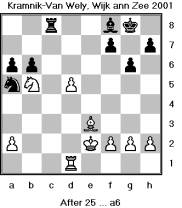
Materially the game is even, but white's d-pawn
is |
|
|
|
far-advanced and supported by the Rook, whose Bishop can |
|
|
also
potentailly protect the queening square(d8). |
|
|
|
An example would be : 26. D6 axb 27. D7 Rd8 and
then Bxb6 |
|
|
and
black has some very difficult choices |
|
|
|
|
|
|
|
|
|
|
|
|
|
|
|
|
|
|
|
|
|
|
|
|
|
|
|
|
|
|
|
|
|
|
|
|
|
|
|
|
|
|
|
|
|
|
|
|
|
|
|
|
|
|
|
|
|
|
|
|
|
|
|
|
|
|
| 2 |
|
|
|
|
|
|
|
|
|
|
|
|
|
|
|
|
|
|
|
|
|
Qxd4 is simply an exchange - and since white is
behind |
|
|
anyway,
a simple exchange is not best. |
|
|
|
|
|
|
|
|
|
|
|
|
after Bxd4+ and the King must give way (the
black Queen can't |
|
recapture since it is pinned |
|
|
|
|
|
|
|
|
|
|
|
|
|
after Bxd4 [Kf6 or Kd6) then white might think
about Bxb7 |
|
|
- and
if so then this would leave black's King in a quite |
|
|
exposed
while white's King is quite safe |
|
|
|
|
|
|
|
|
|
|
|
|
|
|
|
|
|
|
|
|
|
|
|
|
|
|
|
|
|
|
|
|
|
|
|
|
|
|
|
| 3 |
|
|
|
|
|
|
|
|
|
|
|
|
|
|
|
|
|
|
|
|
|
|
|
|
|
|
|
|
|
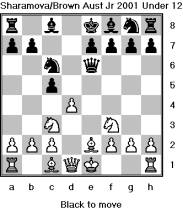
White is threatening to fork Knight and Queen with d5 |
|
|
and while black could simply stop this by
capturing the pawn, |
|
|
chose instead …Nf6 which allows the fork - eg
if d5 …Nxd5 |
|
|
then
either Qxd5 or Nxd5 and white ends up with a piece |
|
|
more
than black |
|
|
|
|
|
|
|
|
|
|
|
|
|
|
|
|
|
|
|
|
|
|
|
|
|
|
|
|
|
|
|
|
|
|
|
|
|
|
|
|
|
|
|
|
|
|
|
|
|
|
|
|
|
|
|
|
|
|
|
|
|
|
|
|
|
| 4 |
|
|
|
|
|
|
|
|
|
Firstly, castling on the Queenside was not wise
since there |
|
|
will be
no castle of pawns round the King ! |
|
|
|
Black's Queen is quite exposed to attack and
not very useful |
|
|
where it is. Preferable would be development of
the black |
|
|
castling Kingside. |
|
|
|
|
|
|
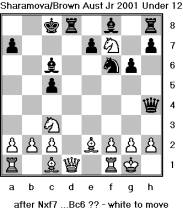
White could simply play Nxf7 forking the two
Rooks, which in |
|
|
fact threatens to win the R on h8 outright -
and not just |
|
|
doesn't
just "winning the exchange" ie a taking a Rook for |
|
|
the
price of only a Knight |
|
|
|
|
|
|
|
|
|
|
|
|
|
also possible is Ba6+
…Kc7 14.Nd5+ …Nxd5 15.Qxd5 …Qb4 |
|
|
16. Nd3 …e6 17 Bf4+ and white is very well developed |
|
|
and has
a crushing attack |
|
|
|
|
| Notes to page
1 |
|
|
|
|
|
|
|
|
|
|
| 5 |
|
|
|
|
|
|
|
|
|
|
|
|
|
|
|
|
|
|
|
|
|
the clue is that b7 is the only flight square from the |
|
|
|
check on
d8. So we are looking for a move that blocks b7, |
|
|
and we don't want to lose our Queen - so a
check is possible |
|
|
that
does all this. |
|
|
|
|
|
|
|
|
|
|
|
|
|
|
It is a forced mate-in-2 moves - Ba6+ [black
can choose to |
|
|
block
with the Bishop with Ba7or Kb8 or Kb7] Qxd8 checkmate |
|
|
|
|
|
|
|
|
|
|
|
|
|
|
|
|
|
|
|
|
|
|
|
|
|
|
|
|
|
|
|
|
|
|
|
|
|
|
|
|
|
|
|
|
|
|
|
|
|
|
|
|
| 6 |
|
|
|
|
|
|
|
|
|
|
|
|
|
|
|
|
|
|
|
|
|
white has an overwhelming position - and
white's own King |
|
|
is very
safe from any attack. |
|
|
|
|
|
|
|
|
|
|
|
|
|
the game might continue : 26 …Qb6 27 Qxe7 (setting up a |
|
|
forecd mate), ...Qb7 Qe2+ !(! Means 'good
move') …Kb6 |
|
|
29 Rd6 (see how white's pieces work together) …a5 30 Qb5+ ! |
|
|
…Kc7 31
Rxc6+ (notice how the white-squared Bishop keeps |
|
|
the
King out of the corner and so the Queen can't protect it) |
|
|
… Kd8 32 Qxb7 and white will mate on the next
move. |
|
|
|
|
|
|
|
|
|
|
if instead of 30 …Kc7 black plays …Ka7 then
31Be3+ …Kb8 |
|
|
(since
Ka8 gets mated on move quicker [Rd8+…Qb8 and |
|
|
|
|
|
|
either R or Q takes on b8 to mate) 32 Rd8+ …Kc7
33 Qxa5+ |
|
|
|
|
|
|
(see
how the Q protects the R) … Qb6 and perhaps we |
|
|
|
|
|
|
should
ask the class to find the mate - Qxb6 checkmate |
|
|
|
|
|
|
|
|
|
|
|
|
|
|
|
|
|
|
|
|
|
|
|
|
|
|
and Yes - Eugenia Sharamova is Under 12 years
old |
|
|
|
|
|
|
|
|
|
|
|
|
|
|
|
|
|
|
|
|
|
|
|
|
|
|
|
|
|