| Notes to page 1 |
|
|
|
|
|
|
|
|
|
|
|
| 1 |
|
|
|
|
|
|
|
|
|
|
|
|
|
|
|
|
|
|
|
|
|
|
|
|
|
|
|
|
|
|
|
|
|
|
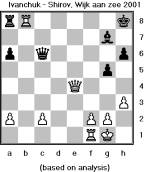
this was a speed game - 10 minutes each, at
this stage I had over five minutes left |
|
|
and my opponent a little over one minute - so I
was pretty confident of |
|
|
|
not losing on time |
|
|
|
|
|
|
|
|
|
|
|
|
|
|
|
|
|
|
although the result should not be in doubt, and
black would normally resign, |
|
|
in speed games the most surprising blunders and
turn-arounds happen |
|
|
|
- so
black played on till the end |
|
|
|
|
|
|
|
|
|
|
|
|
|
|
|
|
|
|
|
|
|
|
|
|
|
|
|
|
|
|
|
|
|
|
|
|
|
|
|
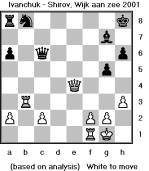
1) 1.Be5+ leads to a more efficient
use of white's pieces...Kc8 black has to move here, since Ka8 loses a piece |
|
|
-
can you see how ? (answer : Nc7+ forking King and Rook 2.Kb3 b5 3.Qf2 Kd7 4.Qc5 Re6 5.Qc7+ Ke8 |
|
|
|
6.Qc8+ Kf7 7.Qd7+ Kf8 8.Qg7+ Ke8 9.Bf6 Rxf6
10.Qe7# |
|
|
|
|
|
|
|
|
|
|
|
|
|
|
|
|
|
|
|
|
although in the game I chose 2) - that almost completely
removed black's chances of winning of |
|
|
|
fighting back (counter-play) |
|
|
|
|
|
|
|
|
|
|
|
|
|
|
|
|
|
|
|
|
|
|
|
1.Qxa6 this gets rid of
black's two pieces bxa6 2.Kxa3 Kb7 3.Kb4 Kc6
4.g5 the black King cannot make progress, |
|
|
this also fixes blacks g-pawn, and when the knight-move Nf6 comes - it
should win with ease Kd6 black had to |
|
|
move the Knig somewhere,
and ...Kb7 would
be met by Ka6 and black runs out of useful moves .Ka5 Kc6 |
|
|
6.Kxa6 Kd6 7.Kxa7 Kc6 8.Nf6 Kb5 9.Bb6 Kc4
10.e5 Kd3 11.e6 Ke2 12.e7 Kf3 13.e8Q h5 14.Qe3+ Kg2 |
|
|
|
15.Qg1+ Kxh3 16.Bf2 h4 17.Qh1# |
|
|
|
|
|
|
|
|
|
|
|
|
|
|
|
|
|
|
|
|
|
|
actually we never played out the game - a few
moves before white was going to Queen a pawn, |
|
|
|
black ran out of time - white had 4 minutes; 20
seconds left |
|
|
|
|
|
|
|
|
|
|
|
|
|
|
|
|
|
|
|
|
|
|
|
|
|
|
|
|
|
|
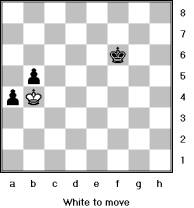
the secret to these type of positions is to know that in the position to |
|
|
the left - white cannot capture the pawn on b5
(without losing that is) |
|
|
since the a-pawn will Queen easily and the King
cannot catch it |
|
|
|
|
|
|
|
|
|
|
|
the same is true for black of course - the pawn
on f5 |
|
|
|
|
is quite safe from capture |
|
|
|
|
|
|
|
|
|
|
|
|
|
|
|
and since neither King can leave the pawns to
help its own pawns |
|
|
-
this position should be agreed drawn |
|
|
|
|
|
-
an adjudicator would judge it a draw |
|
|
|
|
|
|
|
|
|
|
|
|
|
|
|
|
|
|
|
|
|
|
|
|
|
|
|
|
|
|
|
|
|
|
|
|
|
|
|
|
|
|
|
|
|
|
|
|
|
|
|
|
|
|
|
this, however, is completely different |
|
|
|
|
|
we use the fact that white can only move the
King - and so must give way |
|
|
|
|
|
|
|
|
|
|
|
|
|
|
|
|
|
|
|
1.Kc3 Ke5
2.Kb4 Kd4 3.Ka3 Kc3 4.Ka2 b4 5.Kb1 b3 6.Kc1 b2+ |
|
|
7.Kb1 a3 8.Ka2 Kc2 9.Kxa3 b1Q 10.Ka4 Qb6 11.Ka3
Qb3# |
|
|
|
|
|
|
|
|
|
|
|
|
|
|
|
|
|
|
|
|
|
|
|
|
|
|
|
|
|
|
|
|
|
|
|
|
|
|
|
|
|
|
|
|
|
|
|
|
|
|
|
|
|
|
|
|
|
|
|
|
| Notes to page
1 |
|
|
|
|
|
|
|
|
|
|
|
| 1(continued) |
|
|
|
|
|
|
|
|
|
|
|
|
|
|
|
|
|
|
|
|
|
|
|
|
|
|
|
|
|
|
|
|
|
|
|
this is the same position except with no WN
& WB |
|
|
|
|
the straightforward win is like No. 1, just a
little tougher, it is |
|
|
|
still possible to force a win with all the big pieces on - but it |
|
|
|
does give black counter-play and I would certainly |
|
|
|
|
swap off the pieces |
|
|
|
|
|
|
|
|
|
|
|
|
|
|
|
|
|
|
|
|
|
|
|
|
|
|
|
|
|
|
|
|
|
|
|
|
|
|
|
|
|
|
|
|
|
|
|
|
|
|
|
|
|
|
|
|
|
|
|
|
|
|
|
|
|
|
|
|
|
|
1.Kb3 Nb1 [1...Nb5
2.Qxb5 Rb6 A) 3.Kc4 Rxb5 4.Kxb5 Kc7 5.e5 a6+ 6.Kc5 a5 7.Kd5 (7.f5 gxf5 8.gxf5
this may |
|
|
not look it - but it's a draw 8...a4 9.Kb4 b5)
; B) 3.Qxb6 it's important in this case to double black's pawns 3...axb6] |
|
|
2.Qe1 Kc7 3.e5 [3.Qxb1
Rb6+ 4.Kc2 Rxb1 5.Kxb1 Kd6 6.g5 Ke6 7.Kc2 b5 8.Kd3 a5 this shows why it is so
useful to |
|
|
double black's pawns, white has a good
majority of pawns - but with the help of the King can fend of any march |
|
|
up the board. White can't do much against the
connected passed pawns on the Queenside] 3...Rb6+
4.Ka2 trapping |
|
the knight, it might not be captured anytime
soon - but's stuck [4.Kc2 Na3+] 4...Kd7 5.f5 gxf5
6.gxf5 Rb5 |
|
|
7.e6+ Ke8 8.f6 Rf5 9.Qc1 threatening mate on c1 and winning the Knight 9...Ra5+ 10.Kxb1 Rb5+ 11.Ka2 Ra5+ |
|
|
12.Kb3 Rb5+ 13.Ka4 Rd5 14.Qc8+ Rd8 15.Qxb7 [not as efficient (mate in 6 rather than mate-in-3) but
depressing |
|
|
for black 15.f7+ Ke7 16.Qxd8+ Kxd8 17.f8Q+ Kc7
18.e7] 15...Rd4+
anything to avoid mate |
|
|
|
|
16.Ka5 Rd5+ 17.Qxd5 h5 18.Qa8# |
|
|
|
|
|
|
|
|
|
|
|
|
|
|
|
|
|
|
|
|
|
| 2 |
|
|
|
|
|
|
|
|
|
|
|
|
|
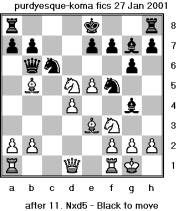
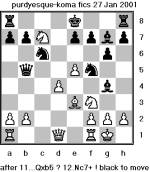
Numbers two and three are two views of the same
question - before and after positions |
|
|
|
| 3 |
|
|
|
|
|
|
|
|
|
|
|
|
|
|
white has just taken a central pawn, black
cannot simply capture |
|
|
the
Bishop on b5 because of the Knight fork Nc7+ |
|
|
|
|
|
|
|
|
|
|
|
|
|
|
|
|
|
|
|
|
|
|
|
|
|
|
|
|
|
|
|
|
|
|
|
|
|
|
|
|
|
|
|
|
| 4 |
|
|
|
|
|
|
|
|
|
|
|
|
|
|
|
|
|
|
|
|
|
|
|
wins the Queen, check must be answered |
|
|
|
|
|
|
|
|
|
|
|
|
|
|
|
|
|
|
|
|
|
|
|
|
|
|
|
|
|
|
|
|
|
|
|
|
|
|
|
|
|
|
|
|
|
|
|
|
|
|
|
|
|
|
|
|
|
|
Rxb8+ |
|
|
|
|
|
|
|
|
|
|
|
|
|
|
|
|
|
|
|
|
|
|
|
|
|
|
|
|
|
|
|
|
|
|
|
|
|